EAGLE SOLUTIONS
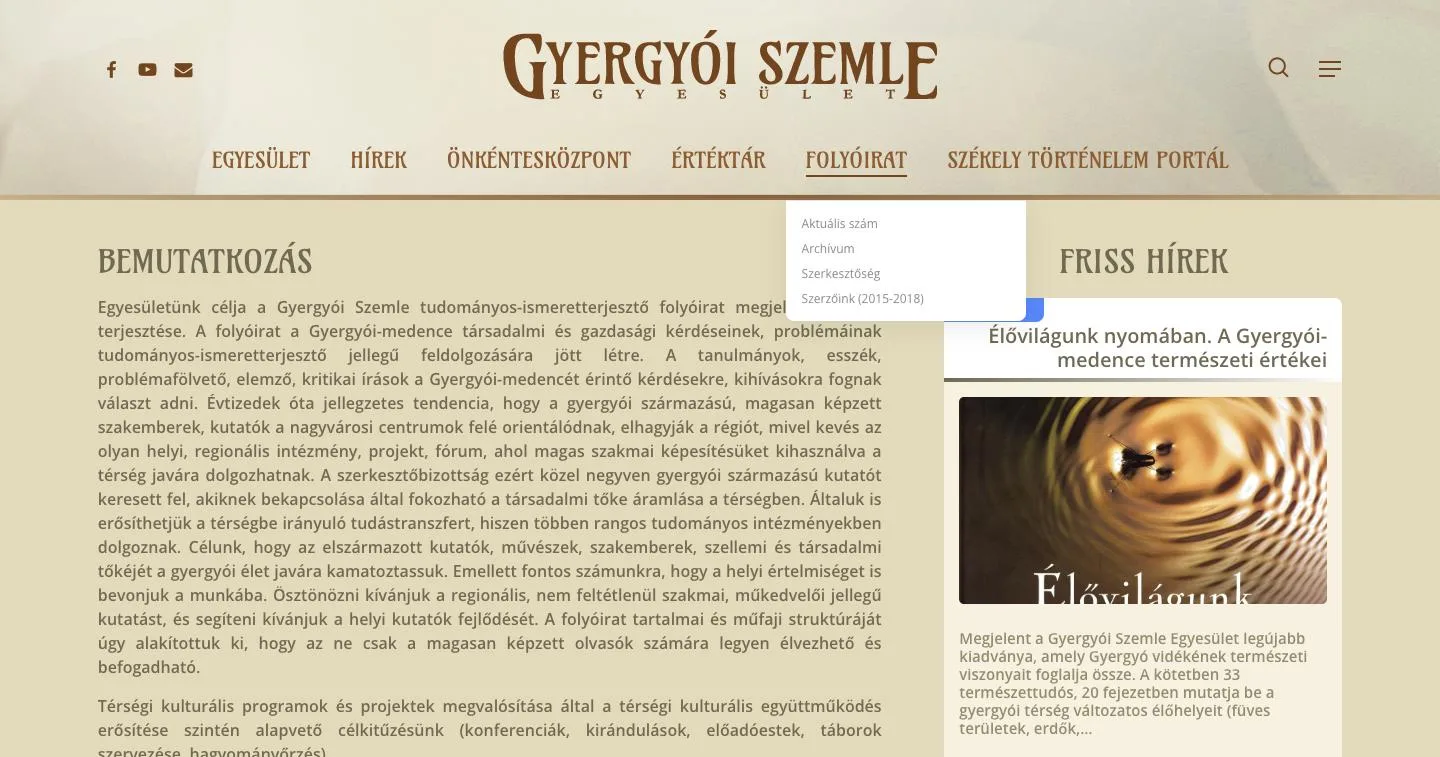
I contributed to the WordPress development of the Gyergyói Szemle Association content portal.
The challenge
The Gyergyói Szemle Association publishes a popular-science journal. On a content portal like this the challenge is the structure: volumes, issues, authors and studies have to be accessible in a way that keeps a ten-year-old piece findable. All of it in three languages, Hungarian, Romanian and English.
The solution
- A WordPress content portal in which issues and studies are organised and searchable.
- A trilingual build (HU/RO/EN), in the interest of the international reach of academic content.
- Content the association's own editorial team can update. For a journal, regular publishing is a given, and you cannot call a developer for every issue.
- Searchability and a clean URL structure, so studies get a citable, durable reference.
My contribution
I worked on the WordPress development side of this project. The editorial work, the academic side of the content structure and the stewardship of the journal are the association's responsibility.
The result
The journal's content is available and searchable online in three languages. With academic content this is no small thing: a study is only useful if it can still be found and cited at the same address years later.
A journal and a portal on one site
The association's site holds two kinds of content together, and that is the real task of the project. On one side the issues of the Gyergyói Szemle journal: the current issue, the archive, the editorial board, the authors: the full structure of a periodical, where old content matters as much as new. On the other side the association's own life: news, events, galleries, a video library, a volunteer centre. The logic of the two is opposite: the journal is archival, the association section is chronological. So they got separate structures under shared navigation.
Heritage collections and local history
The most valuable part of the portal is the collections: the heritage register, the keepers of local values, built heritage, bibliography, a regional reader. These stay relevant for years and decades, and they are exactly what a researcher, a student or a journalist searches for. Their structure is therefore constant: stable addresses, clear categories, and internal links that also surface related material. With a local history collection the greatest loss is for the material to exist but for nobody to find it.
Several editors, different permissions
An association portal is not run by one person. One writes news, another uploads journal issues, another manages galleries. The user roles are set up accordingly: everyone sees and can change what belongs to their job. This is more than convenience. On a site with many editors, most mistakes come from someone touching what they should not.
What exactly I did
In this project I worked on the development side of the content portal, not as sole author: the content, the journal and the collections are the association's work. My part was getting this varied material into a structure that is orderly, fast and maintainable in the long run, and letting the editors run the day-to-day without a developer.