EAGLE SOLUTIONS
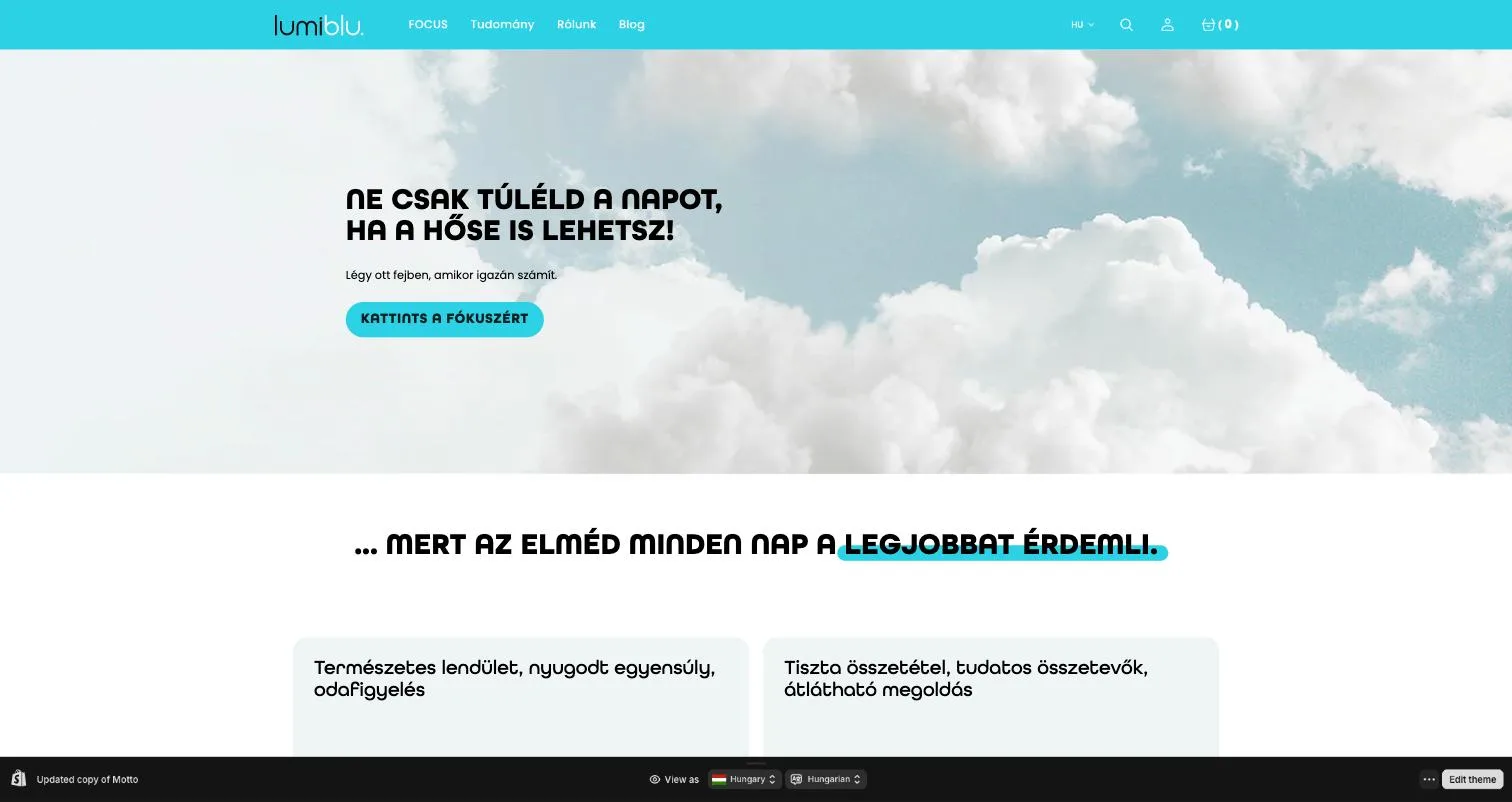
I contributed to the development of the Lumiblu brand online store, in a partner collaboration.
The challenge
Lumiblu is a supplement brand positioned on conscious ingredients and a clean visual identity. Its store runs on Shopify, not WordPress. That is an important part of the story, because WordPress is not the right answer for every project. For a brand preparing for international sales across several languages and markets, Shopify means a lighter operational burden.
The solution
- A Shopify store with an appearance tailored to the brand's identity.
- A product range that can be served in several languages and markets, built on the platform's own international features.
- A clean product page structure that supports conscious ingredient communication: ingredients are an argument, not small print in an appendix.
- A mobile-first purchase flow.
My contribution
I worked on the development side in partnership. Brand building, product strategy and the creative concept are Lumiblu's and the agency team's work.
The result
The brand sells on a platform that does not obstruct international expansion and does not require constant server and plugin update management. This reference is in the portfolio because it shows that platform choice is a decision in its own right: alongside WordPress I also work with OpenCart and Shopify, and the project gives the answer, not habit.
When is Shopify better than WordPress?
The decision depends on three factors. The first is payment and shipping needs: if the store sells into several countries, in several currencies and with several payment methods, Shopify brings that out of the box, while on WooCommerce it is a combination of plugins that has to be maintained. The second is operation: behind Shopify there is no server, no PHP version, no plugin update. For a small team that is real time saved. The third is customisation: if the store's logic is bespoke, WordPress is freer. At Lumiblu the first two weighed more.
Supplements: what the law also governs
Communication in the wellness and supplement category is constrained. Therapeutic effects cannot be claimed, ingredients and daily dose must be stated exactly, and the mandatory information has to be on the product page. The site's structure uses this as an argument: clean composition, a transparent ingredient list and clear dosing are exactly what the conscious buyer is paying for. So the product description meets the legal minimum and builds trust out of it.
International selling in practice
Currency, tax, shipping zone and payment method differ by country, and together they decide whether a cart becomes an order. The store offers the payment methods expected internationally, and shipping terms appear according to the buyer's country instead of being hidden in a general table. A buyer abroad completes the purchase when there are no surprises in the cart.
Why this reference is here
Because it shows a decision. A developer will by default steer you toward the system they know. Alongside WordPress I also work with OpenCart and Shopify, so I can say which is better in the specific situation, even when the answer is that it should not be WordPress.