EAGLE SOLUTIONS
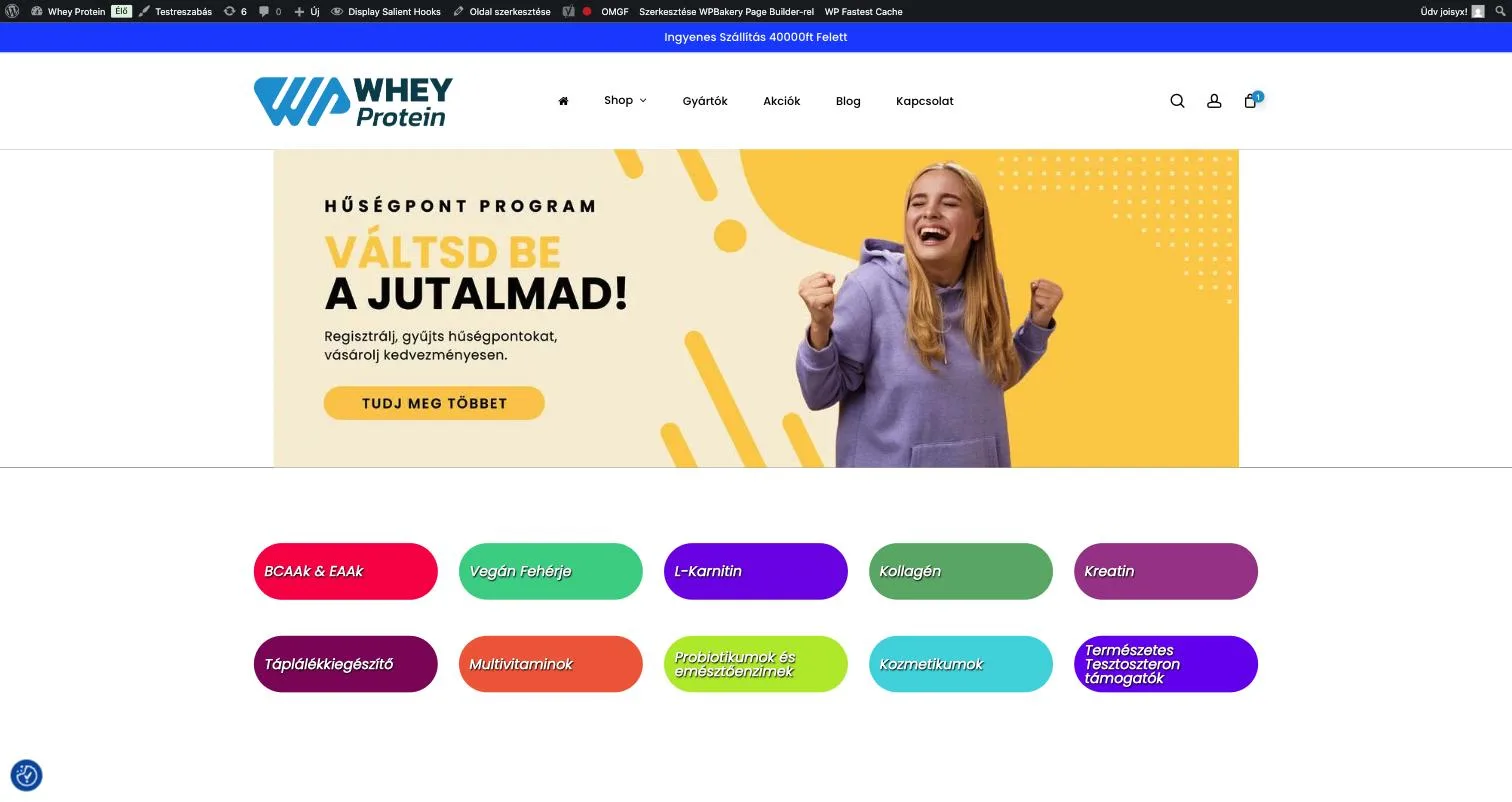
I contributed to the WooCommerce-based development and maintenance of the Whey Protein online store.
The challenge
The Whey Protein supplement store runs a wide product range and a loyalty points programme. In a store like this the challenge is the second purchase: supplements are bought again regularly, so the convenience of the returning customer directly affects revenue. That requires a store that stays searchable with many products, and a loyalty programme that actually works.
The solution
- A WooCommerce store in which a wide range stays manageable through categories and filters.
- Loyalty points: rewarding repeat purchase is part of the system, not a campaign bolted on afterwards.
- Customer accounts with previous orders, so reordering takes a few clicks.
- Continuous maintenance: updates, security, speed. In a store with a large catalogue this is a must.
My contribution
I worked on the WooCommerce development and maintenance side of this project, as a partner. Running the store, product strategy and marketing are the client's and the agency team's work.
The result
The store has been running for years and the maintenance is continuous. In a webshop that matters most: updates, security fixes and keeping the speed up are what turn orders into actual revenue.
A large catalogue that does not fall apart
The supplement market splits into dozens of categories: protein, amino acids, creatine, collagen, vitamins, probiotics, testosterone support, cosmetics. At that catalogue size the category structure decides whether the customer finds what they came for or leaves. The hierarchy therefore follows the buyer's logic rather than the warehouse's. Someone looking for protein picks the type first, then the brand and the flavour.
Brands and flavour variants
The same product usually exists in several sizes and several flavours. If those go up as separate products the catalogue dilutes and search returns the same item eight times. Treated as variants, everything stays on one product page, the customer picks size and flavour there, and stock is tracked per variant. That single decision handles half of the catalogue's size on its own.
Handling promotions
In a supplement store a promotion is part of normal operation: there is always a discount running. So it matters that pricing and promotional periods can be set from the admin and tied to dates. The discount starts and ends by itself, and nobody has to log in at midnight. On listing pages the original and the discounted price then show consistently and unambiguously.
Why operation, not project
An online store is at its best on launch day and degrades from there: WordPress and plugin updates arrive, the database grows, old orders pile up, the site slows down. The store has been running for years and the maintenance is continuous: verified updates, backups, speed monitoring. That way the cart works even when nobody is watching, and orders turn into actual revenue.